The problem
You know a ii–V–I, but when you play it on piano it sounds like a jazz exercise, not a groove. Funky jazz piano keeps the same chords and changes two things: richer voicings (9ths and 13ths) in the right hand, and a syncopated, bouncing bass line in the left hand.
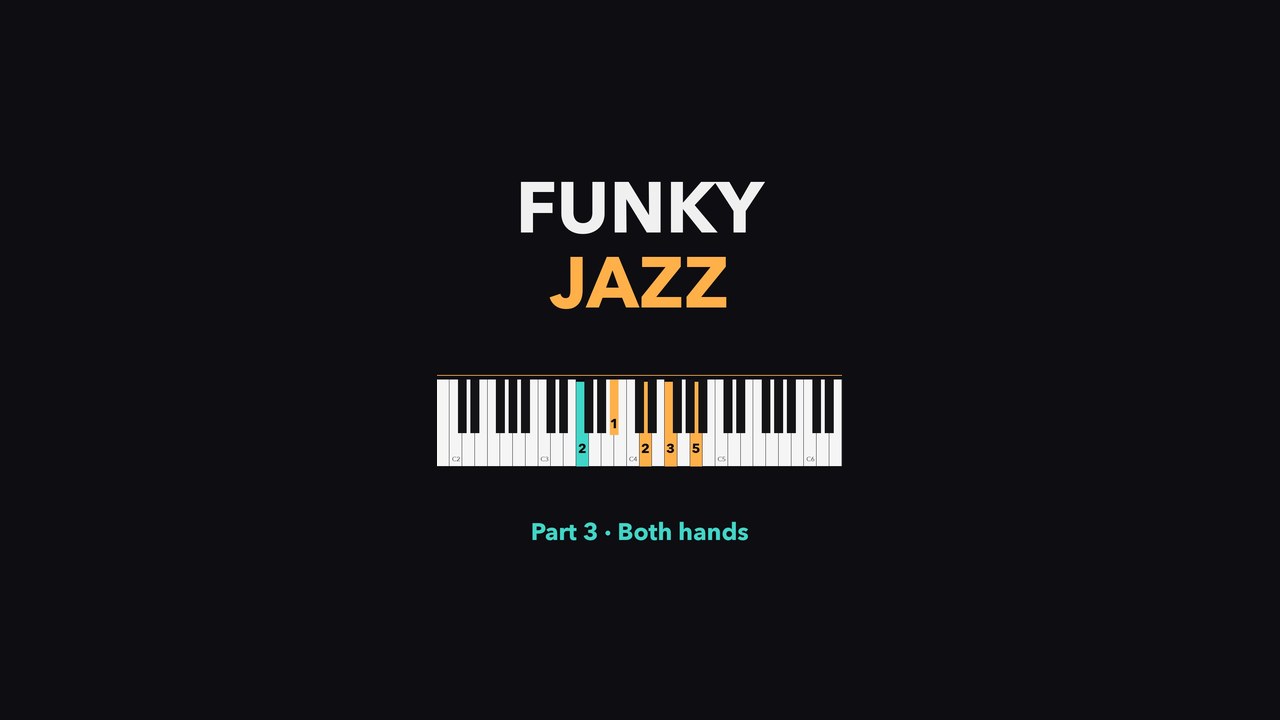
This is the 16-bar piece from our Funky Jazz piano reels, in F at 106 BPM. Below is every chord with the exact notes each hand plays, so you can learn it bar by bar.
Fixes that work in any DAW
- Bars 1–4: the main groove (ii–V–I–VI7)Gm9 – C13 – Fmaj9 – D7#9, one chord per bar. Left hand plays the roots G2, C2, F2, D2. Right hand: Gm9 = Bb D F A, C13 = Bb E A D, Fmaj9 = A C E G, D7#9 = C F F# C. The right-hand shapes barely move: that's what makes them easy to play fast.
- Bars 5–8: the groove again, ending on Am7Gm9 – C13 – Am7 – D7#9. Am7 (the iii chord, right hand C E G B, the B adds a 9th) replaces Fmaj9, and D7#9 pulls back to Gm9. In F, iii often stands in for I.
- Bars 9–12: the bridgeBbmaj9 (IV, right hand A C D F) – Eb9 (bVII9, right hand Db F G Bb) – Am7 – Abm7 to Db9 (right hand Cb Eb Gb Bb). The Abm7–Db9 is a ii–V a half step above Gm, so it slides chromatically back down into the groove.
- Bars 13–16: groove and turnaroundGm9 – C13 – Fmaj9, then Gb13 into C7#9 in the last bar. Gb13 is the tritone substitute for C7: its bass is a half step above F and its 3rd and 7th are the same notes as C7's, so it pulls hard back to the top.
- Make the left hand funkyDon't hold the bass note. Play the root short on beat 1, pop the octave on an offbeat sixteenth, and slide into the next chord from a half step below. Leave space: the rests are what make it groove.
- Make the right hand funkyPlay the chords as short stabs on the offbeats (the 'and' of 2 and 4 work well), with light ghost notes in between. Keep a little swing on the sixteenths rather than playing them perfectly straight.
With MIDI Composer 3.0, step by step
- Open MIDI Composer 3.0Give it a try from the button on this page. It runs in your browser and in Music Pro Access.
- Set the key and tempoChoose F major and a tempo around 106 BPM to match this piece.
- Enter or generate the chordsChange the chords to the progression above, or press New chords to try other progressions in the same key.
- Regenerate the partsPress Regenerate to hear different bass, chord and drum parts over the same progression until one grooves.
- Export the MIDIExport the MIDI file and drag it into your DAW, then play it with your own piano or electric piano.
Tip: Learn it hands separately first: the left-hand groove for bars 1–4 on its own, then the right-hand stabs, then together at a slower tempo. The right-hand shapes for Gm9 and C13 share Bb and D, so move only the notes that change.
Common questions
What key is this funky jazz progression in?
F major. The main groove is ii–V–I–VI7: Gm9, C13, Fmaj9, D7#9.
What is a D7#9 chord?
A D dominant 7th with a sharp 9th (E#, played as F). Here the right hand plays C F F# C over D in the bass: the clash between F and F# is the bluesy 'Hendrix chord' sound.
Why play Gb13 before C7#9?
Gb13 is the tritone substitute for C7. It shares C7's 3rd and 7th, and its bass Gb sits a half step above F, so it leads smoothly back to the top of the form.
Do I need to read music to learn this?
No. Every chord above lists the notes for each hand, and the reels show the keys lighting up with finger numbers.
Can I use these chords in my own track?
Yes. Chord progressions aren't owned by anyone. Change the key, tempo and rhythm to make it yours.