The problem
Bass and drums can be in the same key and tempo while still feeling disconnected. The kick may emphasise one rhythm while long bass notes obscure it, or both parts may add movement at every possible moment.
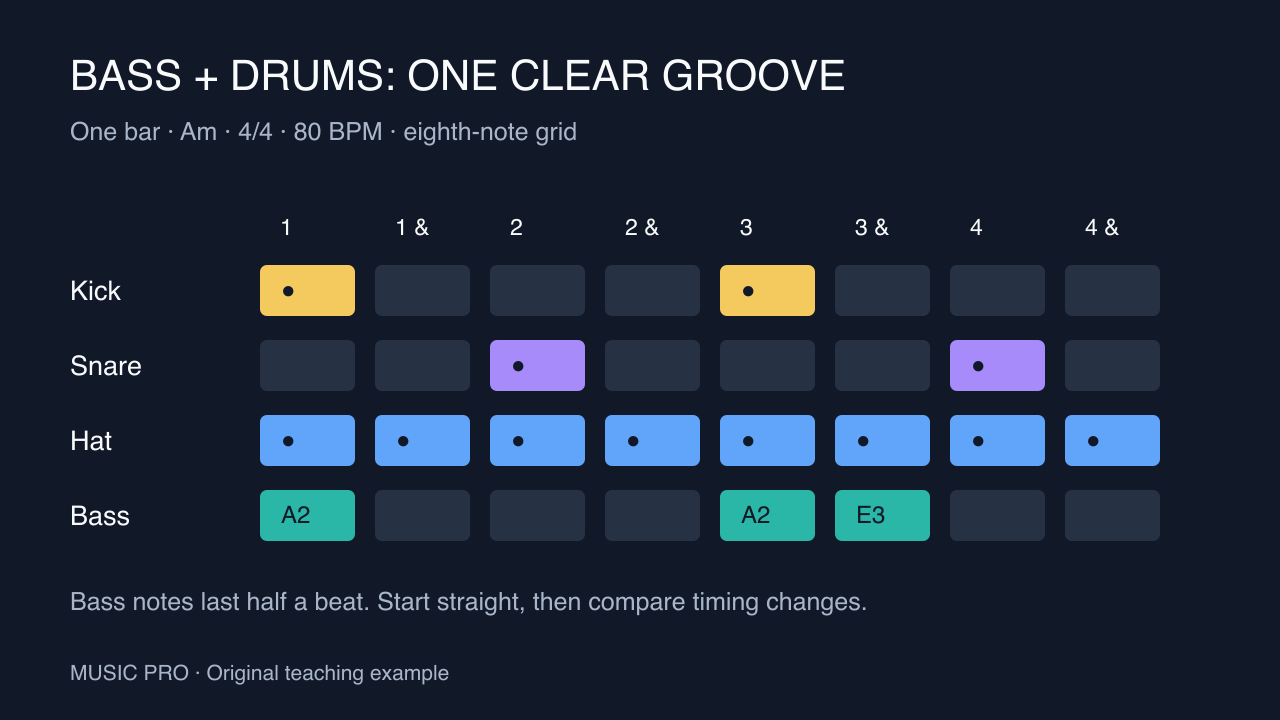
Start with this original one-bar exercise in 4/4 at 80 BPM over Am. Use a short kick, a snare and a pitched bass instrument. It is a rhythm exercise, not a mixing preset: if the two sounds mask one another even with a sparse pattern, sound choice and level need attention too.
Step by step
- Make the drum pattern easy to followCount eight eighth-note positions: 1, 1-and, 2, 2-and, 3, 3-and, 4, 4-and. Put the kick on 1 and 3, the snare on 2 and 4, and a closed hat on all eight positions. Keep the first version straight so you can hear the relationship between parts.
- Anchor the bass to the kickPlay A2, MIDI note 45, on beats 1 and 3. Give each note a half-beat length. The kick and bass now share their main attacks, while the gaps stop the bass from filling the entire bar. An octave label may differ in your DAW; MIDI note 45 identifies the pitch unambiguously.
- Add one offbeat responseAdd E3, MIDI note 52, on 3-and for half a beat. The bass now has three notes: A2 on 1, A2 on 3 and E3 on 3-and. The extra fifth adds movement after the main kick without requiring another kick hit. Compare this with the two-note version before adding anything else.
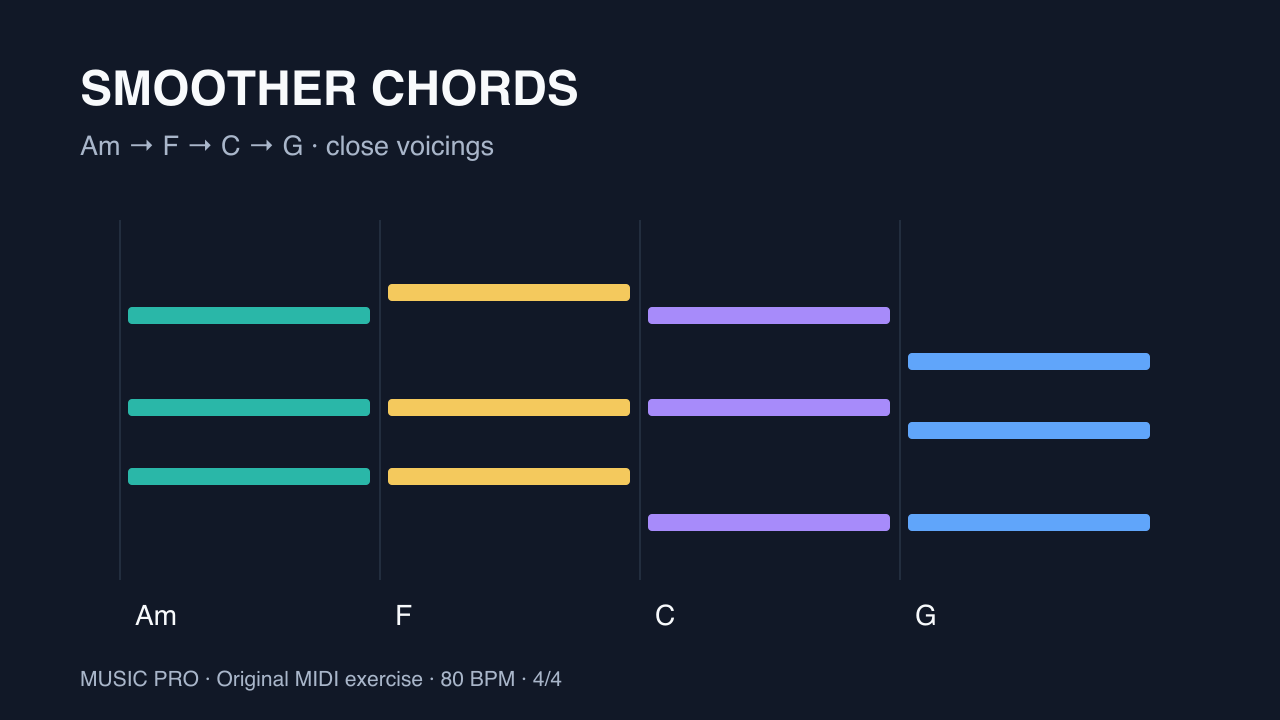
- Follow the next chordExtend the pattern over Am–F–C–G, one chord per bar. For each bar, use its root on beats 1 and 3 and its fifth on 3-and: A2/E3, F2/C3, C2/G2 and G2/D3. Keep the rhythm unchanged initially so you can judge the harmonic movement separately.
- Compare timing without changing the notesDuplicate the pattern before experimenting. Keep the kick and bass anchors together, then try moving selected hats a small amount later. Compare at equal playback level. If it sounds less stable, reduce the shift or return to straight timing. Random timing on every note is not a requirement for groove.
- Explore the relationship in Pocket GrooveIn our Pocket Groove, import a song as audio or MIDI, or choose a demo. Generate a groove and adjust density, swing and fills. Lock a lane you want to keep while trying alternatives in other lanes. Compare Straight with In the pocket, then open the result in the studio to edit and export. Generated notes depend on the source and settings; they need not match this manual exercise.
Tip: If the bass loses weight when the kick enters, first lower one sound and shorten the bass release. A timing change cannot reliably solve every low-frequency masking or phase problem.
Common questions
Should the bass always play with the kick?
No. Shared attacks give a useful foundation, while bass notes between kicks create movement. Start with a clear relationship and add departures deliberately.
Is swing the same as human timing?
Swing changes the spacing within repeated subdivisions. Performance timing can also move individual hits relative to the beat. They can work together, but adding either does not automatically improve a pattern.
Will exported MIDI preserve the bass sound?
No. MIDI preserves performance data, not the instrument audio. Assign bass and drum sounds in your DAW and check note mapping, envelope lengths and playback levels.