The problem
Duplicating a melody and moving every note up four semitones creates parallel major thirds. That is not the same as adding thirds within a key: some notes will fall outside the scale. Even a scale-based harmony still needs checking against the chord at each moment.
This original two-bar example is in C major, 4/4 at 80 BPM. Bar 1 uses C major and bar 2 uses G major. It demonstrates note choices you can enter in a piano roll. It is not a recorded vocal result or a claimed output from a harmony generator.
Step by step
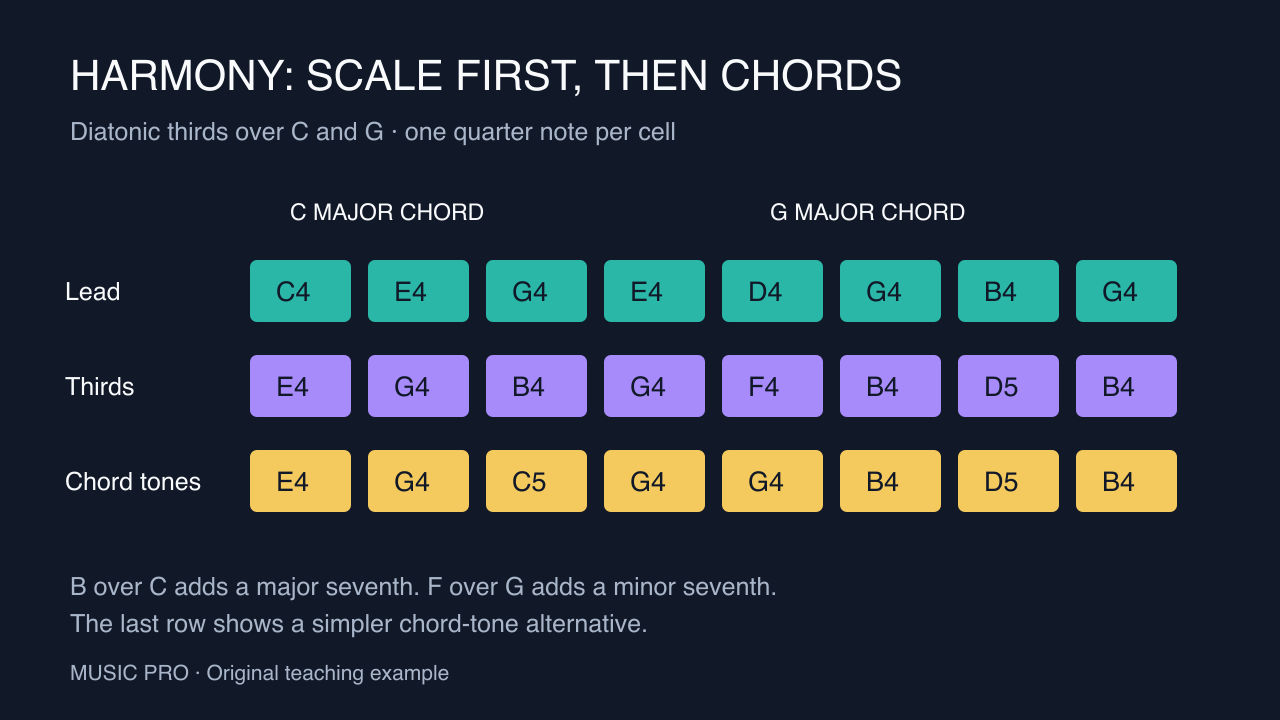
- Write a clear lead lineOver C in bar 1, enter C4, E4, G4 and E4 as quarter notes. Over G in bar 2, enter D4, G4, B4 and G4. With middle C = C4, the MIDI pitches are 60, 64, 67, 64, then 62, 67, 71, 67. Use a plain instrument first so you can judge the intervals.
- Add a third within the scaleCount up three letter names within C major, including the starting note. C goes to E, E to G and G to B. Bar 1 harmony is therefore E4, G4, B4 and G4. Bar 2 harmony is F4, B4, D5 and B4. These thirds alternate between three and four semitones; a single fixed transposition cannot produce all of them.
- Check the harmony against the chordsB over the C chord adds a major seventh. F over the G chord adds a minor seventh. These colours may fit your arrangement, but they are not plain triad notes. For a simpler first pass, replace bar 1 harmony beat 3 with C5 and bar 2 harmony beat 1 with G4. The resulting lines use chord tones at every beat, though those two intervals are fourths rather than thirds.
- Decide where the harmony should stopMute the harmony for the first two beats of bar 1, then let it enter on beat 3. Compare that with harmonising every note. If the lead later contains a fast run, try holding one harmony note or leaving that run unharmonised rather than making a second voice chase every syllable.
- Check range and balancePlay both parts together and then solo the harmony. Make sure its jumps are intentional and its register suits the intended singer or instrument. A MIDI keyboard sound does not demonstrate that a real singer can comfortably perform the part. Keep the lead audible when balancing the two voices.
- Try a generated alternative in Topline HarmoniesIn our Topline Harmonies, load a clear single-voice vocal or humming recording, or select a preset melody. Choose a two-part stack, three-part stack or contrary-motion option, then listen and open the result in the studio. Review the notes against your chords before exporting MIDI. The output is instrument-ready note data, not newly sung vocal audio.
Tip: Choose the harmony for the sound you need. A third can create a richer colour; a chord tone or a rest can make the same phrase clearer. The scale narrows your choices but does not replace listening.
Common questions
Why does a fixed four-semitone harmony sound wrong?
Four semitones always gives a major third. Diatonic thirds within a major scale include major and minor thirds, so the required distance changes with the lead note.
Can Topline Harmonies separate voices from a full song?
It follows one melody line at a time. Use a clear single-voice source rather than chords, stacked vocals or a complete mix.
Does a harmony generator produce finished backing vocals?
Topline Harmonies produces MIDI parts. To make backing-vocal audio, record singers or use a suitable vocal instrument and complete the articulation, lyrics and mix separately.