The problem
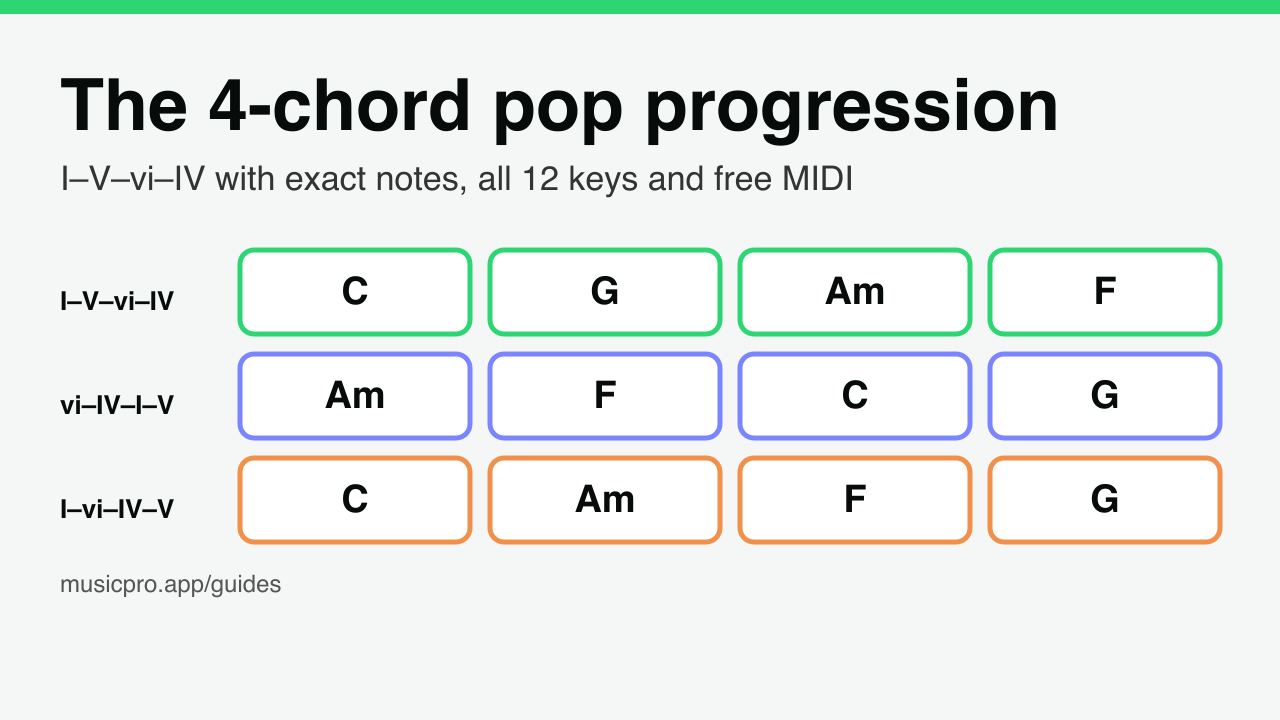
Hundreds of well-known pop songs use the same four chords: I, V, vi and IV. The roman numerals count steps up a major scale: I is the chord on the 1st note, V on the 5th, vi on the 6th and IV on the 4th. Capital numerals are major chords, lowercase is minor. In C major that gives C, G, Am and F. Because the chords are so familiar, the progression feels instantly "right" to listeners, and it leaves plenty of room for a melody.
Many people know the chord names but get stuck moving between them smoothly, or in a key other than C. Below are easy hand positions in C, a chart for all 12 major keys and the three most-used orders of the same four chords. These are original teaching examples, not app output. Octave names use middle C = C4 (MIDI note 60); some programs label that note C3.
Fixes that work in any DAW
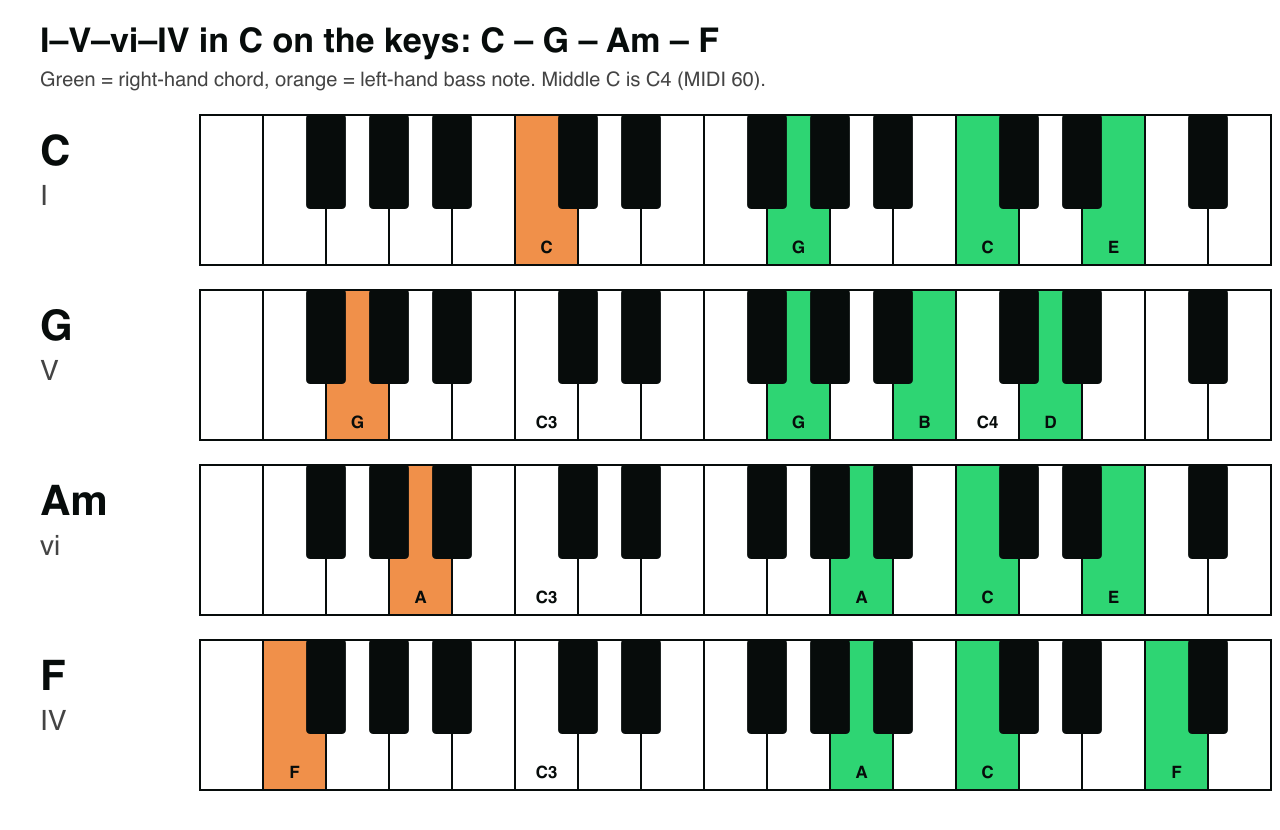
- Build the four chords in CEach chord is three notes, skipping every other white key from its root. C = C E G (I). G = G B D (V). Am = A C E (vi). F = F A C (IV). Only Am is minor; its middle note (C) is three semitones above the root instead of four.
- Right hand: keep the shapes closeInstead of jumping to each root, use inversions (the same notes in a different order) so your hand stays put. C: G3 C4 E4 (MIDI 55, 60, 64). G: G3 B3 D4 (55, 59, 62). Am: A3 C4 E4 (57, 60, 64). F: A3 C4 F4 (57, 60, 65). G3 and C4 are shared by several chords, so most changes move only one or two fingers by a step.
- Left hand: one root notePlay the chord's root low: C3 (48), G2 (43), A2 (45), F2 (41). This keeps the chord names clear even though the right hand plays inversions.
- Try the three common ordersThe same four chords sound different depending on where you start. I–V–vi–IV (C–G–Am–F) sounds bright and hopeful. vi–IV–I–V (Am–F–C–G) starts on the minor chord and sounds more emotional. I–vi–IV–V (C–Am–F–G) is the classic 1950s "doo-wop" order. All three are in the MIDI downloads.
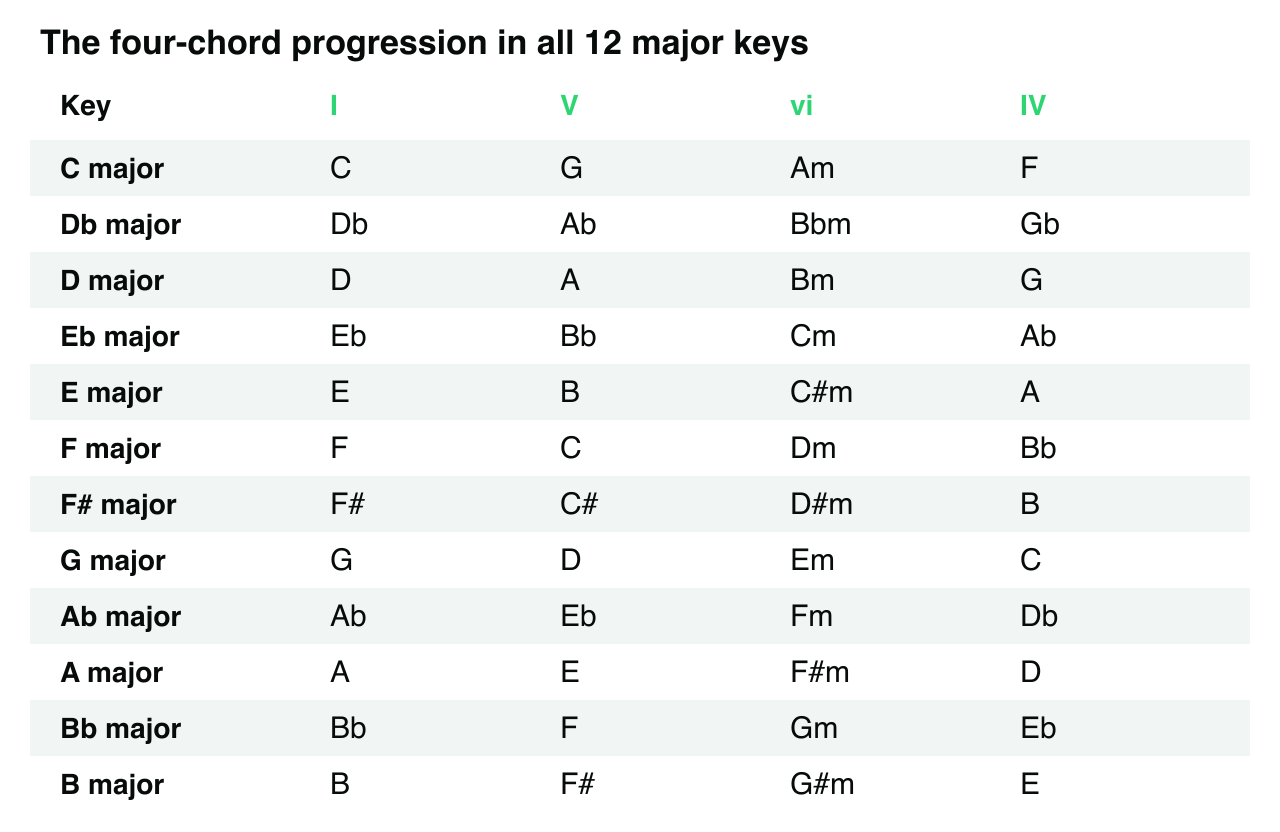
- Play it in another keyUse the chart: pick your key's row and read the four chords across. In G major it is G–D–Em–C, in D major D–A–Bm–G. Choose a key where the melody sits comfortably for the singer; the progression works the same everywhere.
- Give it a rhythmHold each chord for one bar first. Then play the right hand on every beat (1, 2, 3, 4) or in a simple pattern like 1, 2-and, 4 while the left hand holds the root. A steady pattern makes the four chords sound like a finished part instead of a chord chart.
With MIDI Composer 3.0, step by step
- Open MIDI Composer 3.0Open MIDI Composer 3.0 from the Apps page at musicpro.app. It runs in your browser, so there is nothing to install.
- Pick a style and your keyChoose a pop Style, then set the Key to the key you want and the Scale to Major. Set the Bars and Tempo.
- Choose the four-chord progressionOpen the Progression list and under Pop & songwriter pick The Anthem (shown as 1-5-6-4) for I–V–vi–IV. Soft Focus (6-4-1-5) gives vi–IV–I–V and Classic Arc (1-6-4-5) gives I–vi–IV–V.
- Generate and listenPress Generate. The loop opens in the piano roll with chords, melody, bass and drums on their own tracks. Check the chord names against the chart, and click notes to change any you want.
- Export the MIDIClick Export MIDI and open the file in your DAW (the music program you record in), then choose your own piano or synth sounds.
Example MIDI
- Download I–V–vi–IV in C MIDI (C–G–Am–F, 4 bars)
- Download vi–IV–I–V in C MIDI (Am–F–C–G, 4 bars)
- Download I–vi–IV–V in C MIDI (C–Am–F–G, 4 bars)
Assign an instrument to each imported track. MIDI files contain notes, not audio.
Tip: To make the familiar chords sound less familiar, keep the progression but change the rhythm or the bass note: try playing G with B in the bass (G/B) so the bass walks down C–B–A, then up to F.
Common questions
What is the 4-chord progression?
I–V–vi–IV: the chords built on the 1st, 5th, 6th and 4th notes of a major scale. In C major it is C, G, Am, F.
What are the four chords in G major?
G, D, Em and C. The chart in this guide lists all 12 major keys.
Is vi–IV–I–V the same progression?
It uses the same four chords, started from the vi chord (Am–F–C–G in C). It sounds more minor and emotional because it begins and loops back to the minor chord.
Why does this progression appear in so many songs?
The chords all belong to one major key, the roots move by strong steps, and the minor vi chord adds a touch of sadness to an otherwise bright sound. It fits many melodies, so songwriters keep coming back to it.
Can I copyright a chord progression?
Common chord progressions like this one are generally treated as basic building blocks of music rather than something one writer owns. Your melody, lyrics and recording are what make a song yours. This is general information, not legal advice.