The problem
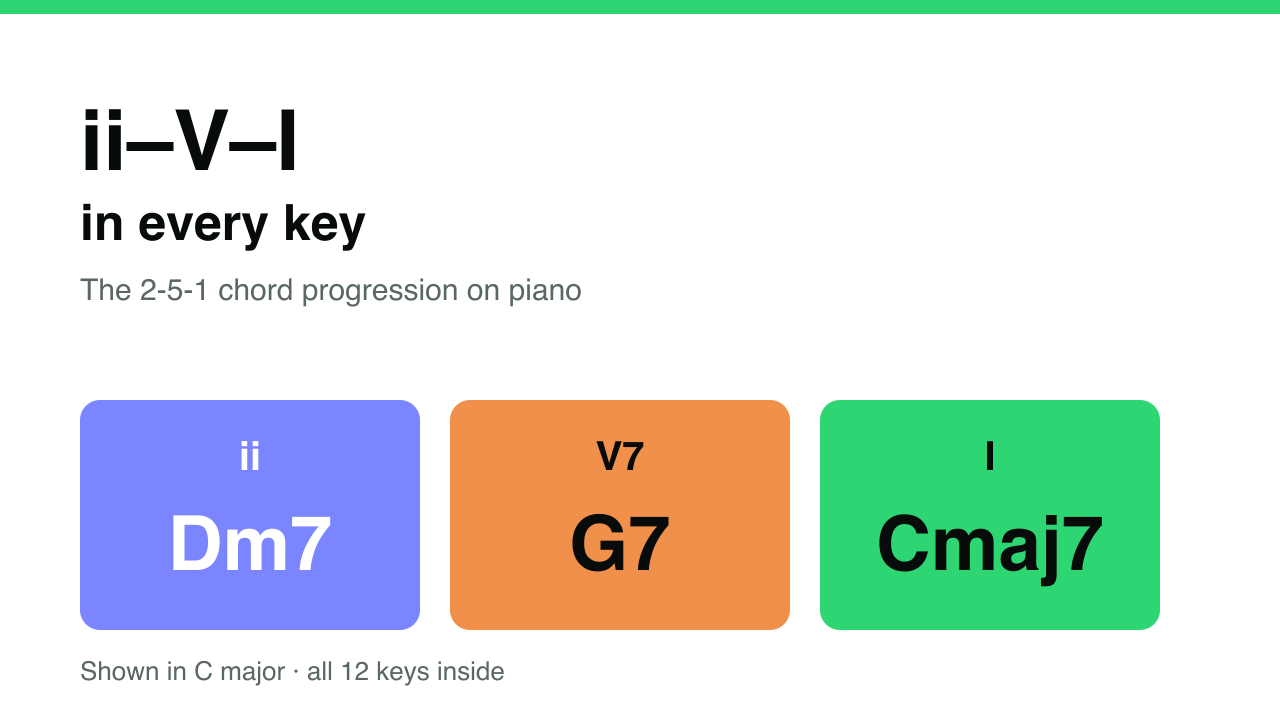
The ii–V–I (said "two-five-one") is one of the most common chord moves in jazz, and it shows up in pop, soul and film music too. The roman numerals count steps up a major scale: ii is the chord built on the 2nd note, V on the 5th, I on the 1st. In C major that gives Dm7, G7 and Cmaj7. The 7 after the letter means a seventh chord: a three-note chord plus one more note, a seventh above the root.
It sounds finished because G7 pulls strongly toward C, and Dm7 leads smoothly into G7 (the roots fall by a fifth each time: D to G to C). The hard part for most players is playing it in every key without fumbling. Below are simple left- and right-hand shapes in C, a chart for all 12 major keys, and the minor version. These are original teaching examples, not app output. Octave names use middle C = C4 (MIDI note 60); some programs label that note C3.
Fixes that work in any DAW
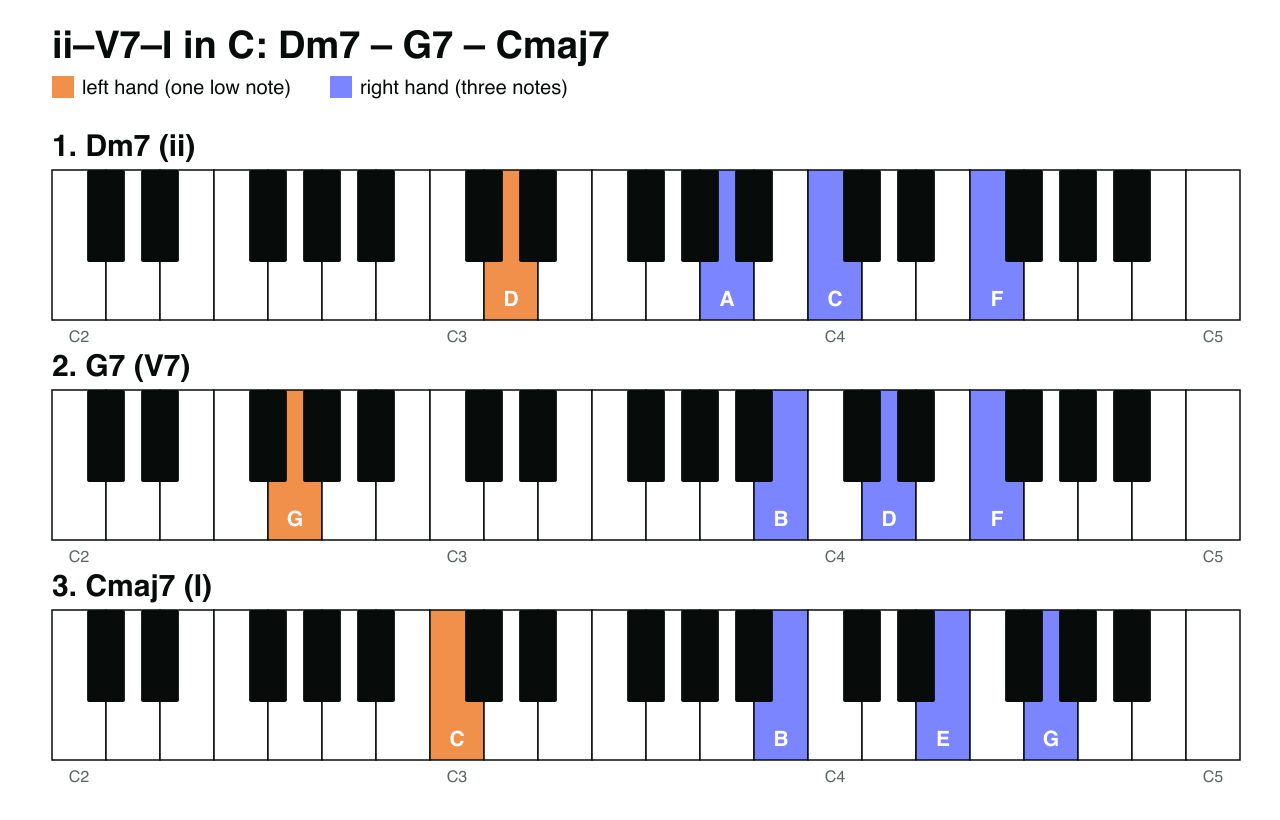
- Build the three chords in CDm7 = D F A C (ii). G7 = G B D F (V7). Cmaj7 = C E G B (I). Each chord is stacked in thirds from its root, so you can find any of them by skipping every other white key: D, F, A, C and so on.
- Left hand: one root note per chordPlay D3 (MIDI 50), then G2 (43), then C3 (48). The root falls a fifth, then rises a fourth to C. Hold each note under the right-hand chord. Keep the left hand low and sparse; it keeps the harmony clear.
- Right hand: three notes that barely moveDm7: A3 C4 F4 (57, 60, 65). G7: B3 D4 F4 (59, 62, 65). Cmaj7: B3 E4 G4 (59, 64, 67). From Dm7 to G7, A moves up to B and C up to D, while F stays. From G7 to Cmaj7, B stays, D goes up to E and F goes up to G. This is voice leading: each finger takes the smallest step to the next chord.
- Know what the shapes leave outThe right-hand Dm7 has no root (the left hand supplies D), and G7 has no root either. That is intentional. Dm7 is A, C and F: the fifth, seventh and third. G7 is B, D and F: the third, fifth and seventh. Notice B, the third of G7, stays put and becomes the seventh of Cmaj7. That shared note is why the change sounds so smooth.
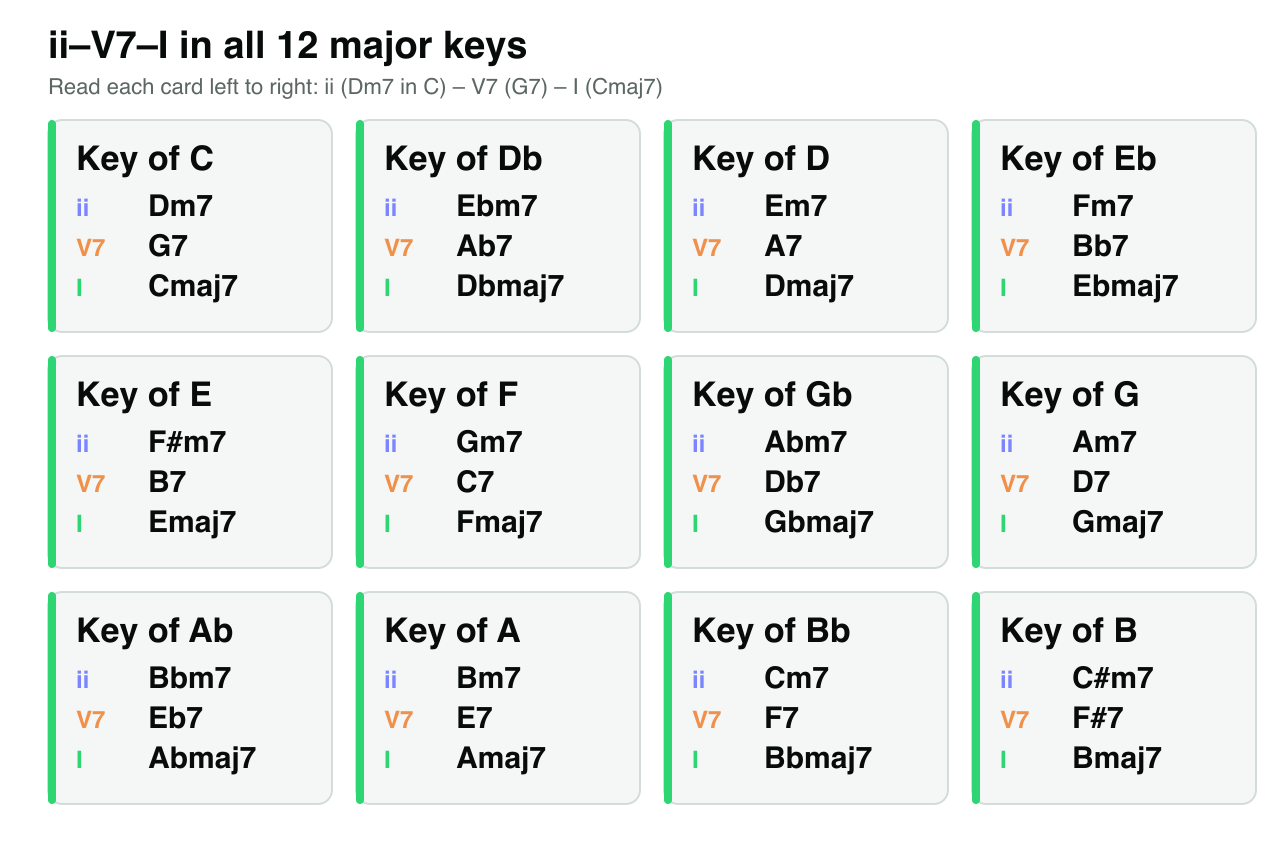
- Play all 12 keysUse the chart figure: in every key the pattern is the same, shifted up or down. The ii chord is minor 7, the V chord is dominant 7 and the I chord is major 7. A good practice order is around the circle of fourths: C, F, Bb, Eb, Ab, Db, Gb, B, E, A, D, G. Each key's ii chord (such as Gm7 in F) sits a fifth above the previous key's I chord, so one move leads into the next.
- Minor ii–V–iIn a minor key the pattern is ii half-diminished, V7, i. In C minor that is Dm7b5 (D F Ab C), G7 (G B D F) and Cm7 (C Eb G Bb). The right-hand shapes are Ab3 C4 F4, then B3 D4 F4, then Bb3 Eb4 G4, with the same left-hand roots D, G and C. G7 still has a natural B, so the pull toward C is just as strong; the lowered third (Eb) in the last chord gives the sad colour.
- Rhythm and repeatGive the first two chords one bar each and the I chord two bars, then go round again. Play each chord on beat 1 and let it ring; later try holding the ii chord for two beats and playing the V on beat 3 so the change arrives sooner.
With MIDI Composer 3.0, step by step
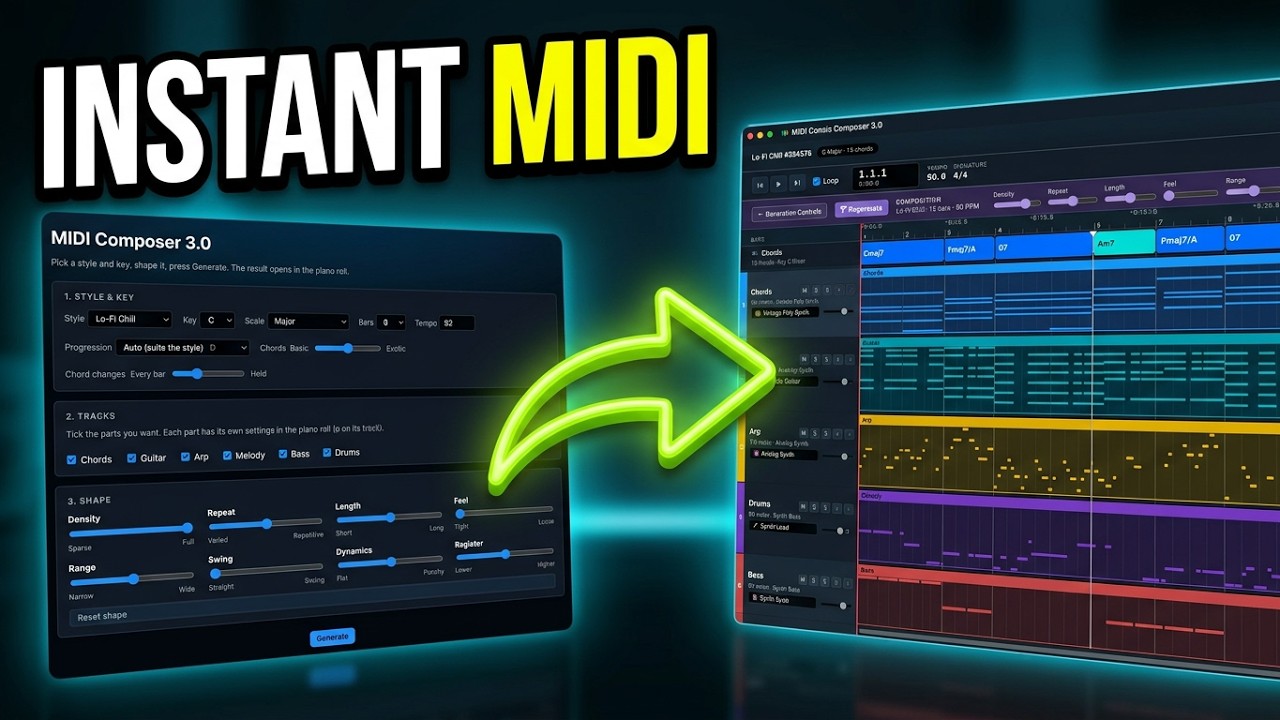
- Open MIDI Composer 3.0Open MIDI Composer 3.0 from the Apps page at musicpro.app. It runs in your browser, so there is nothing to install.
- Pick a style and your keyChoose a Style that suits jazz-flavoured piano, then set the Key and Scale to the key you are practising, for example C and Major. The app lists some keys by their sharp name: C# is the same key as Db, and F# the same as Gb. Set the Bars and Tempo.
- Aim for a ii–V–IOpen the Progression list and pick Blue Hour (shown as 2-5-1-6, under Soul & jazz): it starts with a ii–V–I. Or leave it on Auto, turn the Chords slider toward the richer end for seventh chords and press New chords until you see a ii–V–I move. Always check the chord names shown against the chart.
- Generate, then listen and editPress Generate. The loop opens in the piano roll with each part on its own track. Click a chord note to move it, or retype the notes to match the exact Dm7, G7 and Cmaj7 voicings in this guide.
- Export the MIDIClick Export MIDI and open the file in your DAW (the music program you record in). The chord track uses a piano sound; play along with it in other keys.
Example MIDI
- Download the ii–V–I in C MIDI (4 bars)
- Download ii–V–I in all 12 keys MIDI (48 bars, C then each key up a semitone, Db to B)
Assign an instrument to each imported track. MIDI files contain notes, not audio.
Tip: Practise one key a day at a slow tempo, hands separate first. When it is easy in C, start with the right-hand chord in the next key from the chart and let the same small movements carry you through.
Common questions
What does ii–V–I mean?
It is a chord progression built on the 2nd, 5th and 1st notes of a major scale. In C major that is Dm7, G7 and Cmaj7. Capital numerals (V, I) are major or dominant chords; lowercase (ii) is minor.
What is a 2-5-1 progression?
The same thing as ii–V–I, written with plain numbers. Musicians say "two-five-one".
What is the ii–V–I progression in the key of G?
Am7, D7, Gmaj7. The chart in this guide shows all 12 major keys.
Why is the V chord a 7 chord?
The seventh (F in G7) creates tension with the third (B), and both want to move: B up to C, F down to E. That tension is what makes the I chord feel like home.
Do I always need seventh chords?
No. Plain triads (Dm, G, C) also work and are a fine place to start. The sevenths add the smooth, jazzy sound and the shared notes between chords.
Is there a minor version?
Yes. In C minor use Dm7b5, G7 and Cm7. It is written ii–V–i with a lowercase i for the minor home chord.