The problem
A sad chord progression usually starts and ends on a minor chord, so the music feels like it settles somewhere dark rather than bright. In a minor key the home chord is written with a lowercase i, and the other chords are numbered by the step of the scale they are built on. Lowercase numerals are minor chords, capital numerals are major.
Below are four tried-and-tested minor loops in A minor, chosen because A minor uses only white keys plus one G# for the last two loops. Each comes with exact notes for both hands and a MIDI file. These are original teaching examples, not app output. Octave names use middle C = C4 (MIDI note 60); some programs label that note C3.
Fixes that work in any DAW
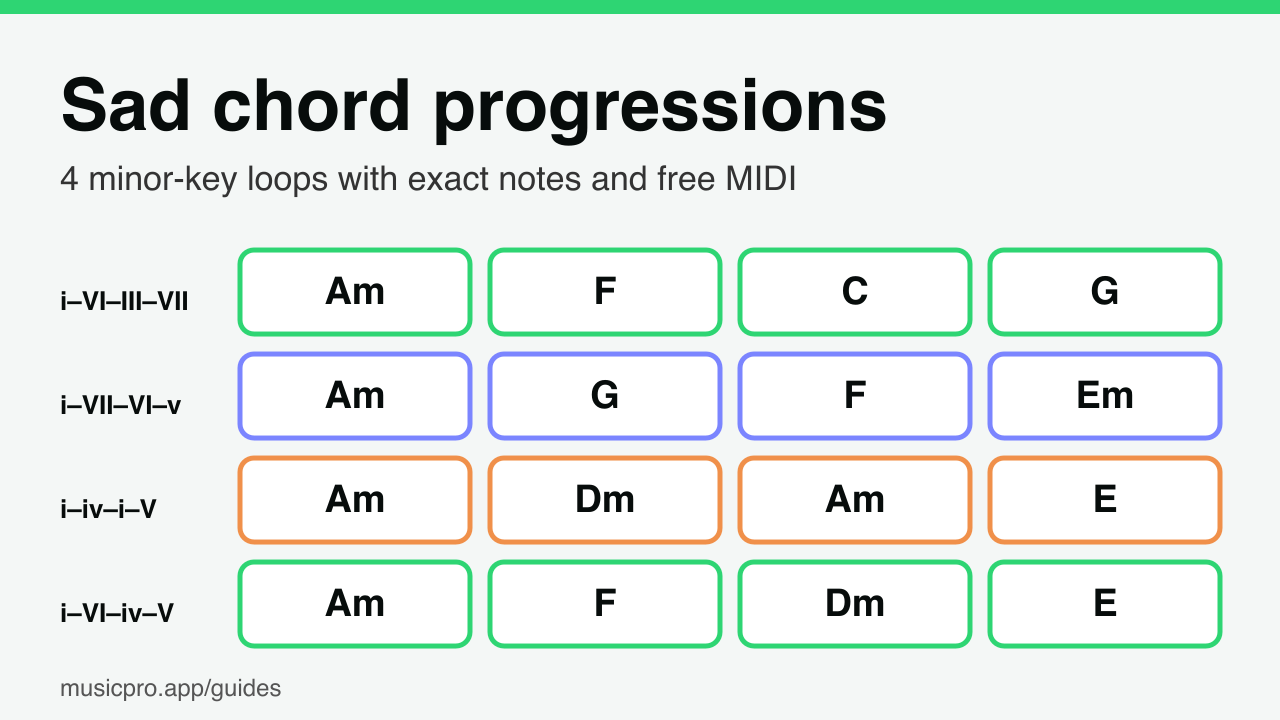
- Loop 1: i–VI–III–VII (Am–F–C–G)The most common minor-key loop in modern pop and film music. Right hand: Am A3 C4 E4 (MIDI 57, 60, 64), F A3 C4 F4 (57, 60, 65), C G3 C4 E4 (55, 60, 64), G G3 B3 D4 (55, 59, 62). Left hand roots: A2, F2, C3, G2. It feels sad but hopeful, because three of its four chords are major.
- Loop 2: i–VII–VI–v (Am–G–F–Em)The bass walks straight down A, G, F, E, which sounds like sighing or falling. Right hand: Am A3 C4 E4, G G3 B3 D4, F A3 C4 F4, Em G3 B3 E4 (55, 59, 64). Left hand: A2, G2, F2, E2. Swap Em for E major (G#3 B3 E4) and you get the classic flamenco-style "Andalusian" cadence.
- Loop 3: i–iv–i–V (Am–Dm–Am–E)Short and serious, like a ballad or a slow waltz. Right hand: Am A3 C4 E4, Dm A3 D4 F4 (57, 62, 65), Am again, E G#3 B3 E4 (56, 59, 64). Left hand: A2, D3, A2, E2. The E major chord uses G#, a note from the harmonic minor scale, which leans strongly back to A.
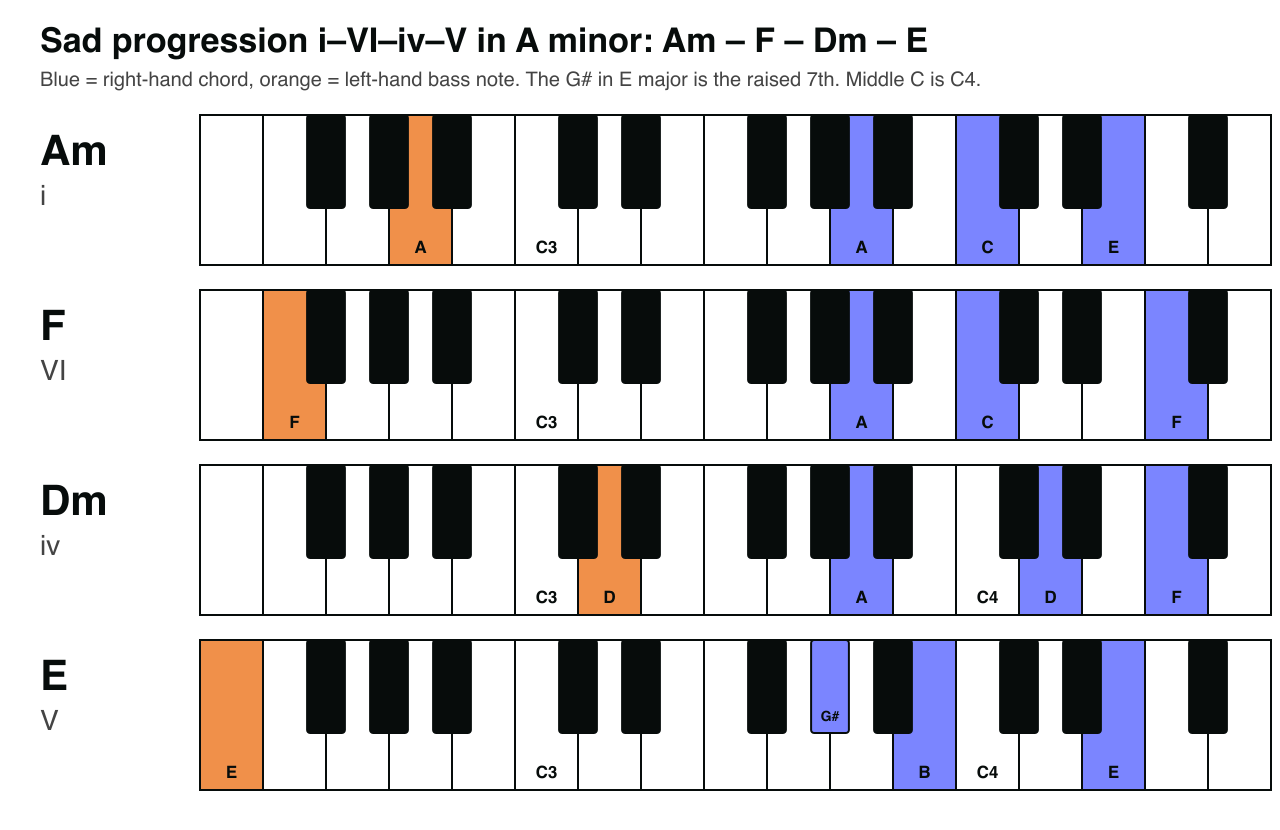
- Loop 4: i–VI–iv–V (Am–F–Dm–E)The darkest of the four. Right hand: Am A3 C4 E4, F A3 C4 F4, Dm A3 D4 F4, E G#3 B3 E4. Left hand: A2, F2, D3, E2. The figure shows it on the keys. Notice A3 is held through the first three chords, which keeps the sound smooth and heavy.
- Why minor chords sound sadA minor chord's middle note (the third) is one semitone lower than in a major chord: A C E instead of A C# E. That small drop gives the darker colour. Slow tempos (60 to 80 BPM), soft playing and long held chords make any of these loops sound sadder still.
- Move a loop to another keyShift every note by the same amount. For D minor, move everything up five semitones: Loop 1 becomes Dm–Bb–F–C. For E minor, up seven: Em–C–G–D. In a DAW you can select all the notes in the MIDI file and transpose them in one go.
With MIDI Composer 3.0, step by step
- Open MIDI Composer 3.0Open MIDI Composer 3.0 from the Apps page at musicpro.app. It runs in your browser, so there is nothing to install.
- Set a minor keyChoose a Style that suits slow, emotional music, then set the Key to A (or any key) and the Scale to Natural Minor. Set a slow Tempo, such as 70 BPM.
- Pick a minor progressionOpen the Progression list and look under Minor & dark. Epic Rise (1-6-3-7) gives Loop 1, Lament (1-7-6-5) gives Loop 2, and Two Step (1-4-1-5) gives Loop 3. In Natural Minor the 5 chord is minor (Em in A minor); change its G to G# in the piano roll if you want the stronger E major pull.
- Generate and listenPress Generate. The loop opens in the piano roll with each part on its own track. Check the chord names, and edit any note by clicking it.
- Export the MIDIClick Export MIDI and open the file in your DAW. A soft piano, strings or a warm pad suits these progressions.
Example MIDI
- Download Loop 1: i–VI–III–VII MIDI (Am–F–C–G)
- Download Loop 2: i–VII–VI–v MIDI (Am–G–F–Em)
- Download Loop 3: i–iv–i–V MIDI (Am–Dm–Am–E)
- Download Loop 4: i–VI–iv–V MIDI (Am–F–Dm–E)
Assign an instrument to each imported track. MIDI files contain notes, not audio.
Tip: Play the right hand a little after the bass on each chord change, and let the last chord ring for twice as long. Small timing choices like this make a simple minor loop sound much more emotional.
Common questions
What is the saddest chord progression?
There is no single answer, but i–VI–iv–V (Am–F–Dm–E in A minor) and the descending i–VII–VI–v (Am–G–F–Em) are among the most commonly used for sad music. Tempo, sound and melody matter as much as the chords.
What are sad chords in C major?
The minor chords of C major: Dm, Em and Am. Starting and ending on Am, such as Am–F–C–G, makes a C major song sound sad, because Am is the relative minor of C.
Why does the E chord have a G# in A minor?
A minor's own fifth chord is Em (E G B). Raising G to G# makes it E major, whose G# is one semitone below A, so it pulls strongly back to the home chord. This comes from the harmonic minor scale.
Can a sad song use major chords?
Yes. Loop 1 has three major chords and still sounds sad because it begins and ends on Am. A slow tempo and a falling melody also help.
What tempo works for sad progressions?
Usually 60 to 85 BPM. The MIDI files in this guide are set to 70 BPM; change the tempo in your DAW to taste.