The problem
Plain major and minor chords sound bright and clear, which is the opposite of the soft, dusty feel of lofi hip hop. Lofi chords lean on seventh and ninth chords (a seventh adds one more note a step below the octave; a ninth adds the note a step above the root, played an octave higher) and on short loops that go round and round without a big finish.
The four loops below are original teaching examples, not output from any app. Each is four bars, one chord per bar, at 80 BPM, in notes you can play on any keyboard or type into a piano roll. Octave labels use middle C = C4 (MIDI note 60); some programs call that note C3, so shift by an octave if your sound comes out too high or low. Four MIDI downloads, one per loop, are listed near the end.
Fixes that work in any DAW
- Why lofi chords sound the way they doThree things do most of the work. First, extra notes: a Cmaj9 (C, E, G, B, D) is softer and more open than a plain C chord. Second, minor-key colour: ninth chords on minor chords (Dm9, Am9) give the mellow, slightly sad mood. Third, small steps: each chord often keeps two or three notes from the one before, so the loop glides instead of jumping. The result is a progression that sounds relaxed and can repeat for minutes without tiring the ear.
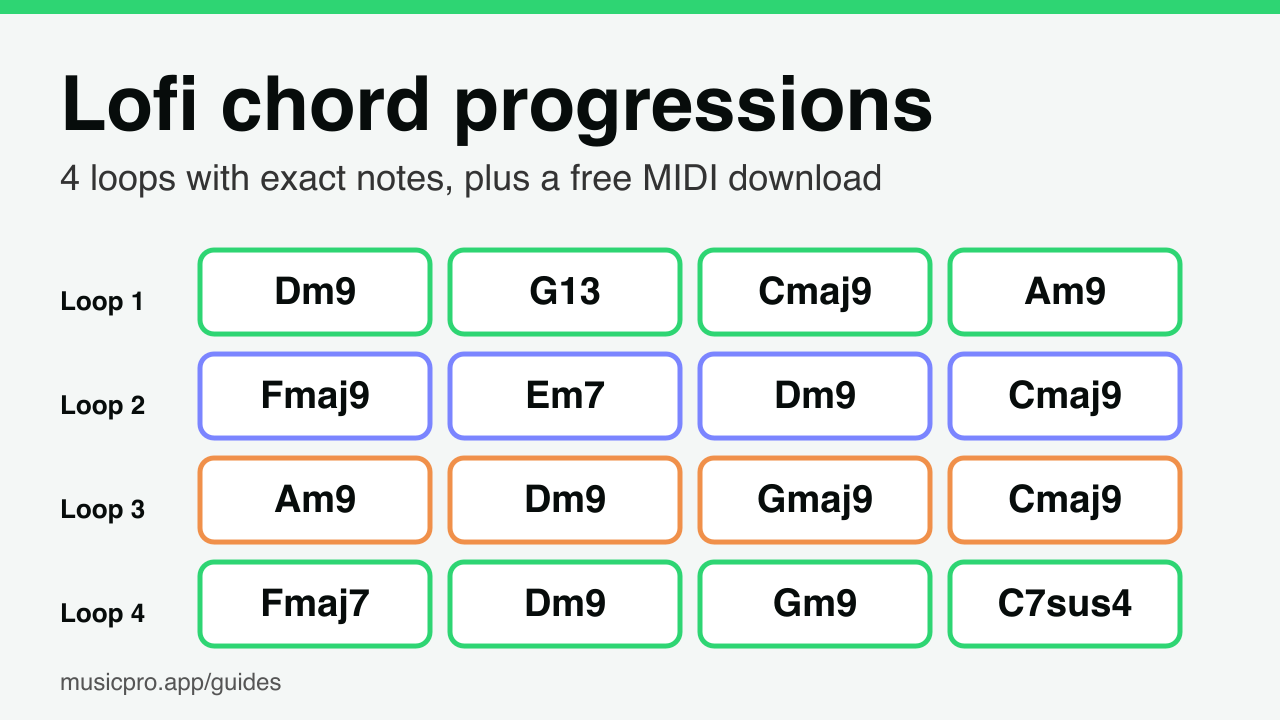
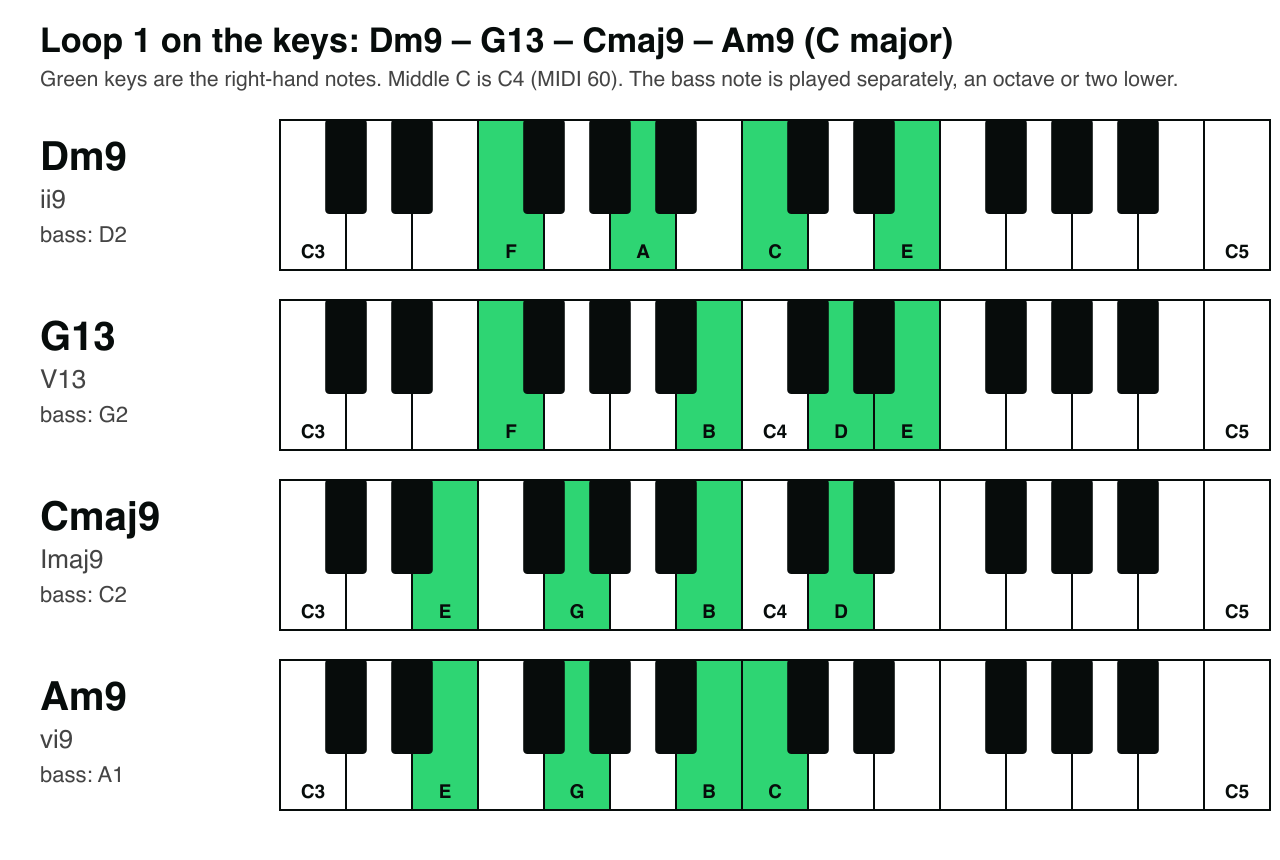
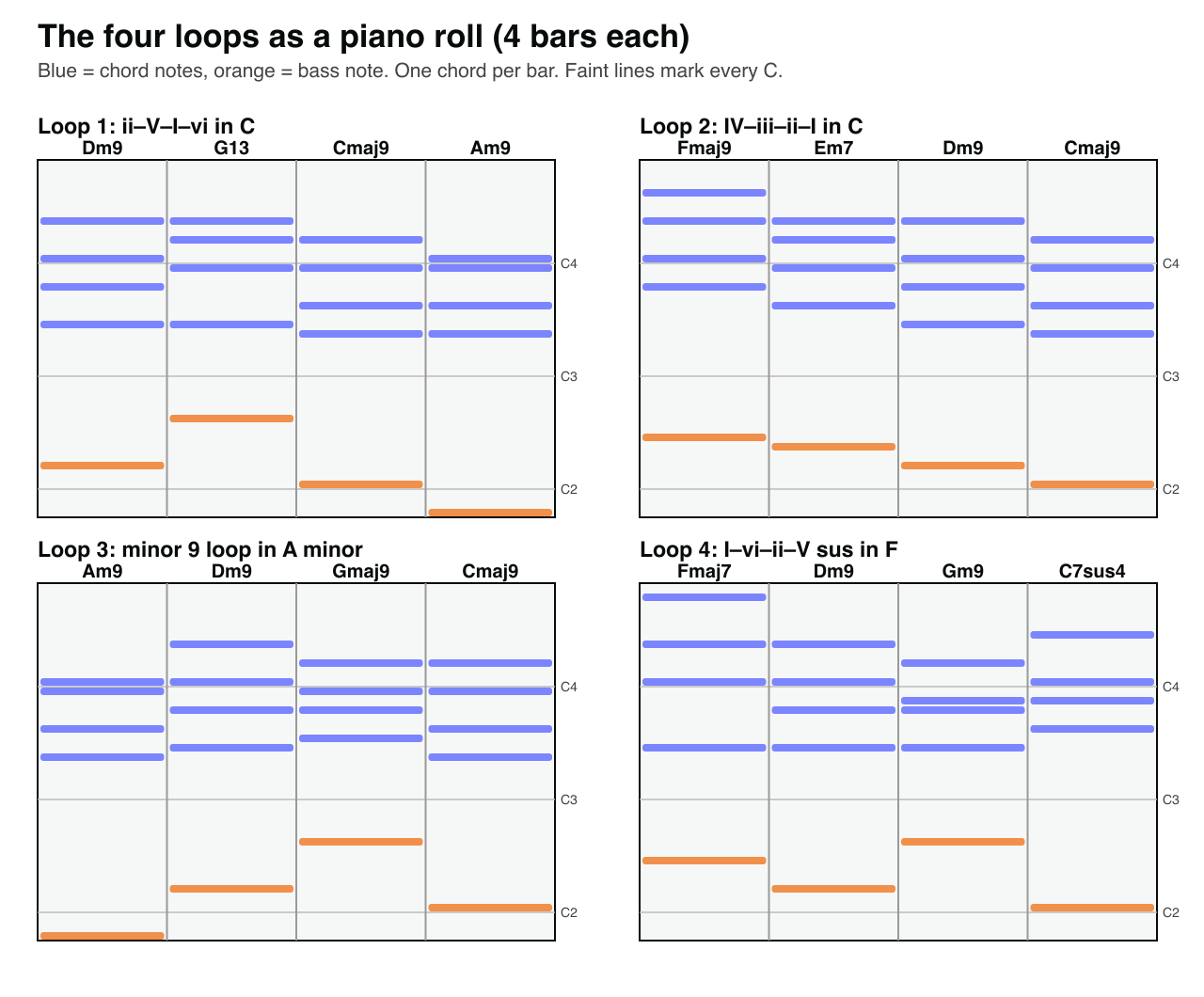
- Loop 1: ii–V–I–vi in C major (Dm9 – G13 – Cmaj9 – Am9)The classic jazz move, relaxed. Roman numerals are ii9, V13, Imaj9, vi9. Right hand: Dm9 = F3 A3 C4 E4 (MIDI 53, 57, 60, 64); G13 = F3 B3 D4 E4 (53, 59, 62, 64); Cmaj9 = E3 G3 B3 D4 (52, 55, 59, 62); Am9 = E3 G3 B3 C4 (52, 55, 59, 60). Bass, one note per bar: D2, G2, C2, A1 (38, 43, 36, 33). The right hand leaves out the root because the bass supplies it; that is why four notes are enough.
- Loop 2: IV–iii–ii–I in C major (Fmaj9 – Em7 – Dm9 – Cmaj9)A falling loop: each chord steps down one note of the scale until it lands on home. Roman numerals: IVmaj9, iii7, ii9, Imaj9. Right hand: Fmaj9 = A3 C4 E4 G4 (57, 60, 64, 67); Em7 = G3 B3 D4 E4 (55, 59, 62, 64); Dm9 = F3 A3 C4 E4 (53, 57, 60, 64); Cmaj9 = E3 G3 B3 D4 (52, 55, 59, 62). Bass: F2, E2, D2, C2 (41, 40, 38, 36), walking straight down.
- Loop 3: minor 9 loop in A minor (Am9 – Dm9 – Gmaj9 – Cmaj9)The rainy-day loop. Roman numerals in A minor: i9, iv9, ♭VIImaj9, ♭IIImaj9 (the flat sign means the chord sits on the scale note a half step lower than in A major). Right hand: Am9 = E3 G3 B3 C4 (52, 55, 59, 60); Dm9 = F3 A3 C4 E4 (53, 57, 60, 64); Gmaj9 = F#3 A3 B3 D4 (54, 57, 59, 62); Cmaj9 = E3 G3 B3 D4 (52, 55, 59, 62). Bass: A1, D2, G2, C2 (33, 38, 43, 36). Going back from Cmaj9 to Am9 moves only one note (D down to C), so the loop turns over smoothly.
- Loop 4: Imaj7–vi9–ii9–V7sus4 in F major (Fmaj7 – Dm9 – Gm9 – C7sus4)A turnaround that never quite finishes. The last chord, C7sus4, replaces the third (E) with the fourth (F), so it hangs in the air and pulls back to the start. Right hand: Fmaj7 = F3 C4 E4 A4 (53, 60, 64, 69); Dm9 = F3 A3 C4 E4 (53, 57, 60, 64); Gm9 = F3 A3 A#3 D4 (53, 57, 58, 62); C7sus4 = G3 A#3 C4 F4 (55, 58, 60, 65). Bass: F2, D2, G2, C2 (41, 38, 43, 36). A#3 is the same key as B-flat 3.
- Make it sound lofi in your DAWThe notes are only half of it; the feel is the other half. Play each chord slightly late (a few hundredths of a second after the beat) and let the notes of a chord land a little apart instead of exactly together. Lower the velocity (how hard each note is struck) so chords sit around 50 to 75 out of 127, and vary it a little. Add swing, which delays every second sixteenth note, to anything that repeats. Choose a soft, mellow keys sound, such as an electric piano or a felt piano, and roll off the very top with a gentle low-pass filter. The downloaded MIDI is deliberately straight and even, so you can add this feel yourself and hear the difference.
With MIDI Composer 3.0, step by step
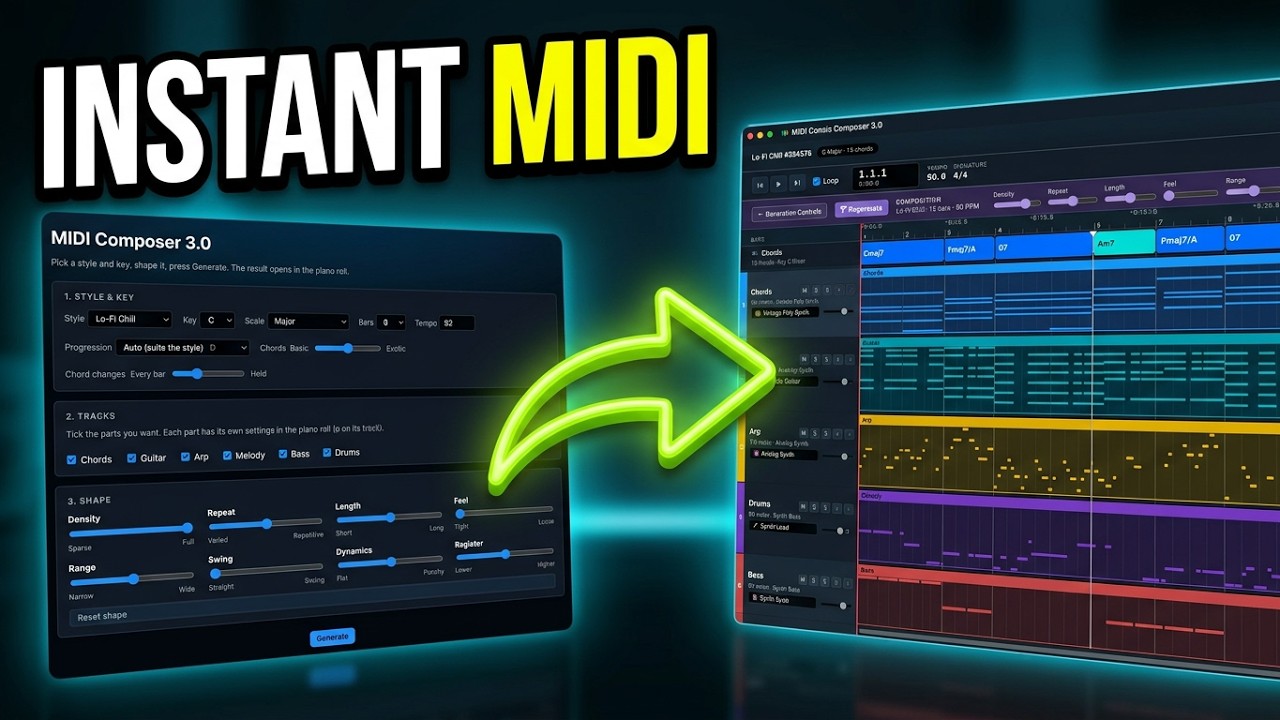
- Open MIDI Composer and choose the Lo-Fi Chill styleOn the MIDI Composer 3.0 start screen, set Style to Lo-Fi Chill (leave Recipe unset so Style is shown), and set Key to match the loop you want to compare (C, A minor or F). The tempo follows the style, and you can change it at any time.
- Generate and listenPress New chords to roll a chord progression until one feels right, then press Generate to build the song over those chords. The result opens in the piano roll. After the first Generate, untick + chords to keep the same chords while you try a new arrangement.
- Compare with the four loops herePlay your generated chords next to Loop 1 to 4 from the download. Notice whether yours use sevenths and ninths and whether the chords move in small steps. Both are good signs for a lofi sound.
- Edit the chords by handIn the piano roll, move a note or two of the chord part. For example, swap one chord for a Cmaj9 voicing from Loop 1. Small edits keep the mood and make the idea yours.
- Export the MIDI and add the feelPress Export MIDI in the studio top bar, drop them on a soft keys sound in your DAW, then apply the late timing, lower velocity and swing from the last section above.
Example MIDI
- Download Loop 1 MIDI: Dm9 – G13 – Cmaj9 – Am9
- Download Loop 2 MIDI: Fmaj9 – Em7 – Dm9 – Cmaj9
- Download Loop 3 MIDI: Am9 – Dm9 – Gmaj9 – Cmaj9
- Download Loop 4 MIDI: Fmaj7 – Dm9 – Gm9 – C7sus4
Assign an instrument to each imported track. MIDI files contain notes, not audio.
Tip: If a loop sounds too busy, play only three notes of each chord and let the bass do the rest. Lofi works because it leaves space.
Common questions
What are the most common lofi chord progressions?
Loops built from ii–V–I, IV–iii–ii–I and minor ninth chords, such as Am9 – Dm9 – Gmaj9 – Cmaj9, are common starting points. These four loops are original examples of those ideas, not copies of any song.
What does 9th chord mean?
A ninth chord is a seventh chord plus one more note: the ninth, which is the note two scale steps above the root, played an octave higher. Cmaj9 is C, E, G, B and D. It sounds richer and softer than a plain C chord.
Why does the right hand leave out the root note?
The bass plays the root on its own track, so the right hand can use those notes for colour. If you play the chords with no bass, add the root at the bottom of each chord.
What tempo do lofi beats use?
Many sit between about 70 and 90 BPM. The examples use 80 BPM. MIDI Composer's Lo-Fi Chill style starts at 82 BPM, and you can change it.
Can I use these progressions in my own music?
Yes. They are short original teaching examples, and chord progressions themselves are a common musical language.