The problem
You can play a plain C–F–G on piano, but neo soul chords sound warm, smoky and a little unresolved, and it is hard to see why. The answer is mostly in the voicing, which means which notes you play and in which order. Neo soul takes ordinary progressions and stacks extra notes on top: the 9th, the 11th and the 13th. It also slides between chords by a half step (the distance between two neighbouring keys, black or white).
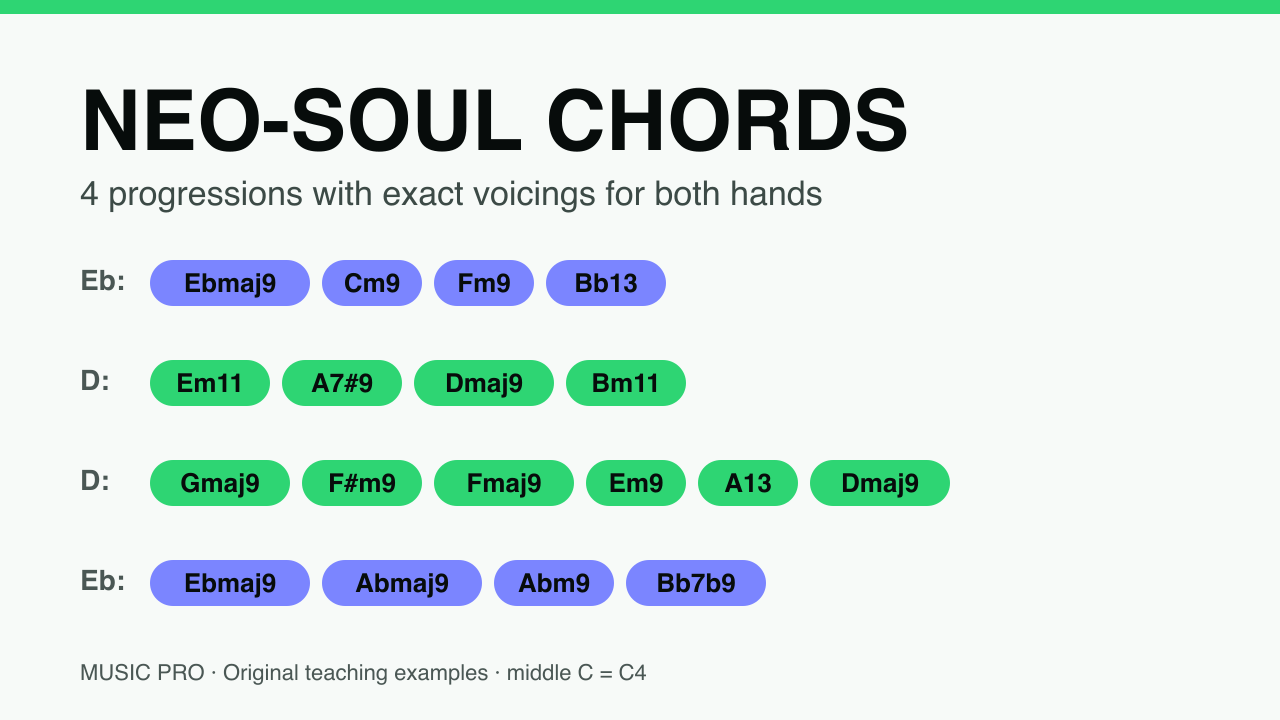
Below are four original four-bar progressions in Eb and D with every note listed for each hand, roman numerals next to the chord names, and a MIDI file for each one. They are teaching examples, not output from any app. Octave names use middle C = C4 (MIDI note 60); some programs call that note C3, so check yours.
Fixes that work in any DAW
- What makes a chord sound neo soulFour ingredients. Major 9th chords (maj9, for example Ebmaj9 = Eb G Bb D F) add the 7th and the 9th to a major triad. Minor 9th and minor 11th chords (m9, m11) add the same extra notes to a minor triad. Dominant 13th chords (the V chord with a 13th, for example Bb13) are the 'about to resolve' chord, dressed up. And altered dominants, such as A7#9 or Bb7b9, add a tense 9th that is a half step off the normal one. You never need to play all five or six notes: the 3rd, the 7th and one extra tone are enough.
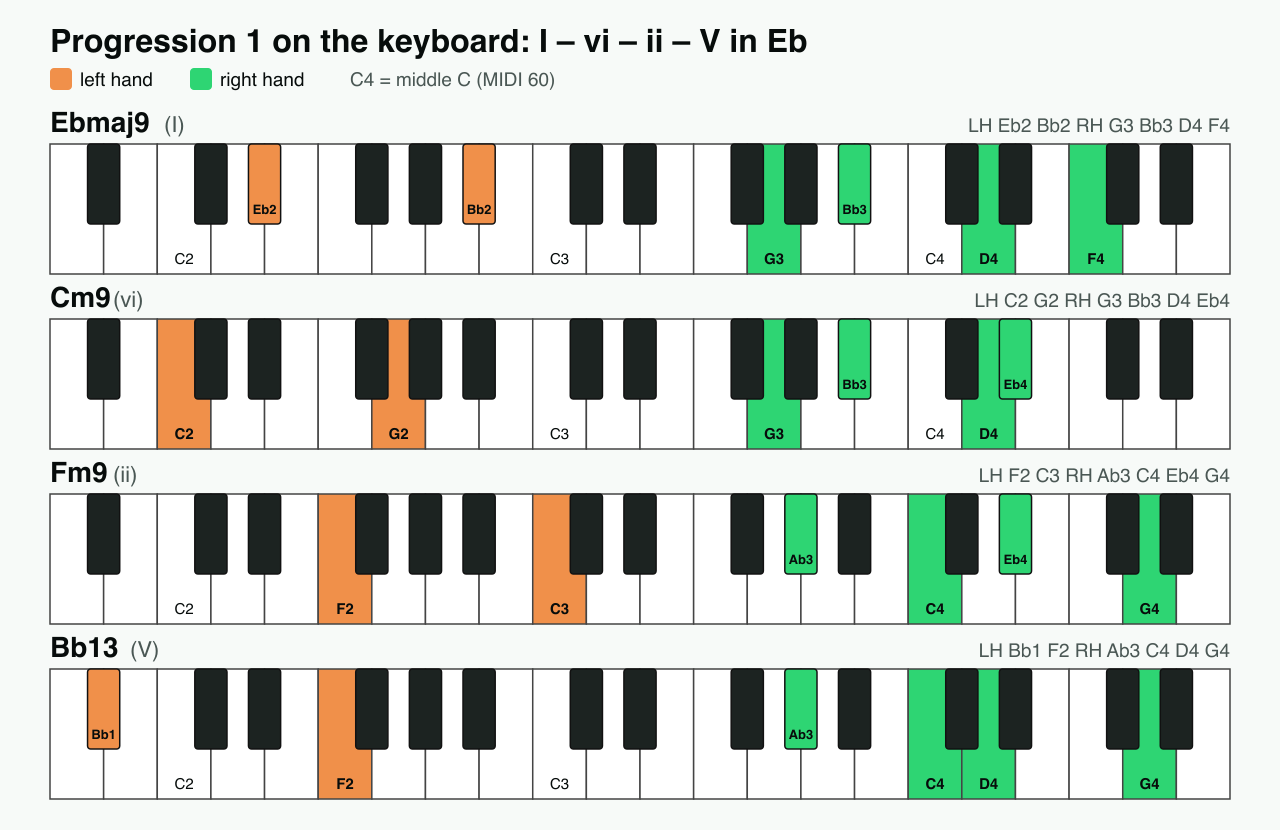
- Rootless voicings: leave the root to the left handA voicing is one particular way of arranging a chord's notes. In a rootless voicing the right hand plays the 3rd, 5th, 7th and 9th, and the left hand supplies the root (plus the 5th). This is how every progression here is built: for Ebmaj9 the left hand plays Eb2 and Bb2, and the right hand plays G3 Bb3 D4 F4, which is the 3rd, 5th, 7th and 9th. The right-hand notes alone spell Gm7 and that is fine: over an Eb in the bass the ear hears Ebmaj9.
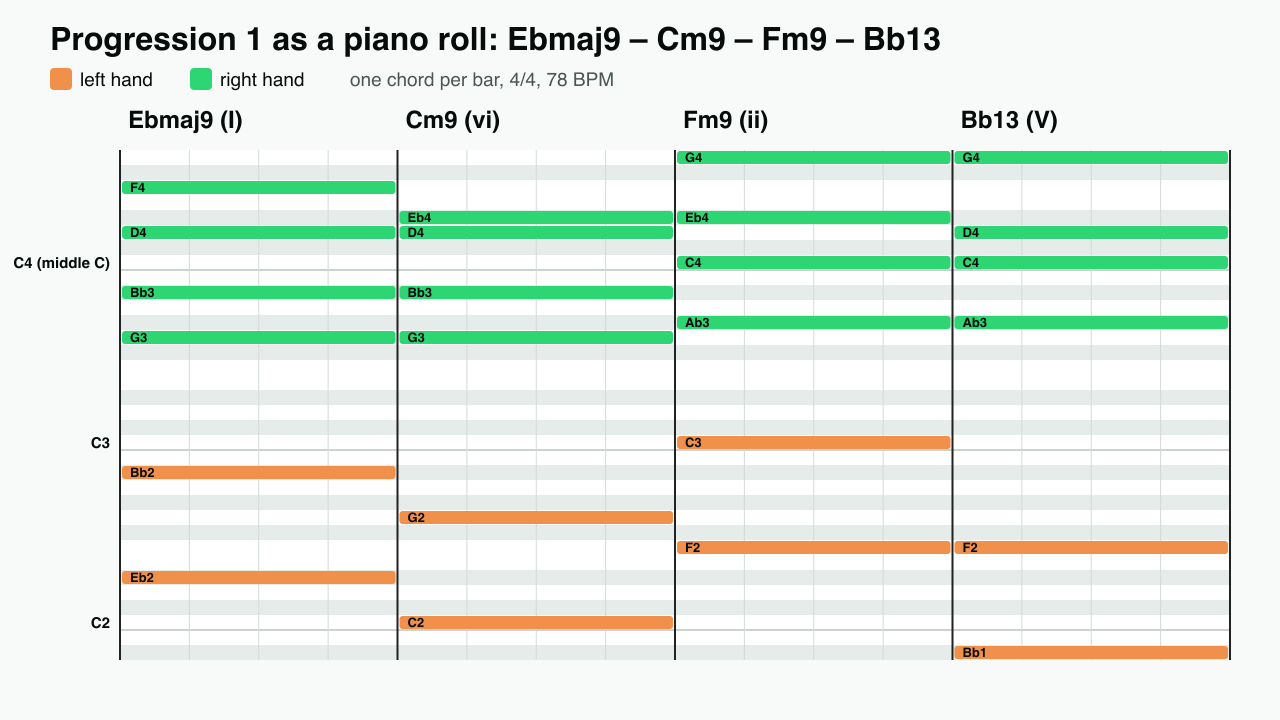
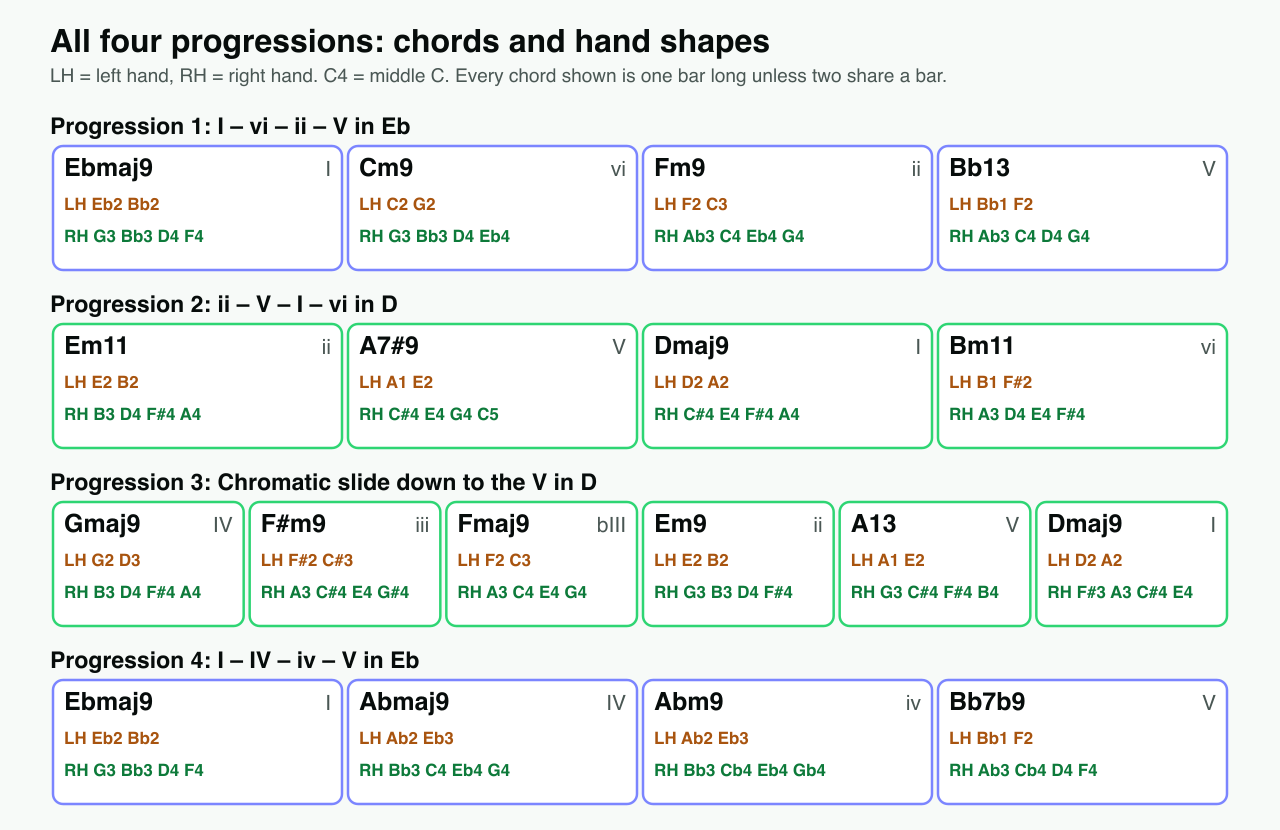
- Progression 1, in Eb: I – vi – ii – V (Ebmaj9 – Cm9 – Fm9 – Bb13)One chord per bar. Left hand, root and fifth: Eb2 Bb2, then C2 G2, then F2 C3, then Bb1 F2. Right hand: Ebmaj9 = G3 Bb3 D4 F4; Cm9 = G3 Bb3 D4 Eb4; Fm9 = Ab3 C4 Eb4 G4; Bb13 = Ab3 C4 D4 G4. From Ebmaj9 to Cm9 only one finger moves (F4 down to Eb4), and from Fm9 to Bb13 only one finger moves (Eb4 down to D4). Bb13 is the 7th, 9th, 3rd and 13th of Bb. Back to the top, Ab3 falls to G3, C4 to Bb3 and G4 to F4.
- Progression 2, in D: ii – V – I – vi (Em11 – A7#9 – Dmaj9 – Bm11)Left hand: E2 B2, then A1 E2, then D2 A2, then B1 F#2. Right hand: Em11 = B3 D4 F#4 A4 (the 5th, 7th, 9th and 11th of Em, which together look like a Bm7 chord); A7#9 = C#4 E4 G4 C5 (the 3rd, 5th, 7th and sharp 9th of A, the bluesy 'Hendrix' chord because C and C# are in the same chord); Dmaj9 = C#4 E4 F#4 A4; Bm11 = A3 D4 E4 F#4. Going from A7#9 to Dmaj9, C# and E stay where they are, G falls to F# and the top C falls to A.
- Progression 3, in D: the chromatic slide (Gmaj9 – F#m9 – Fmaj9 – Em9 – A13 – Dmaj9)IV – iii – bIII – ii – V – I. Two chords share each of the first two bars (two beats each), then A13 fills bar 3 and Dmaj9 fills bar 4. The roots fall a half step at a time (G, F#, F, E), and the right hand slides down with them: Gmaj9 = B3 D4 F#4 A4; F#m9 = A3 C#4 E4 G#4; Fmaj9 = A3 C4 E4 G4; Em9 = G3 B3 D4 F#4. Left hand: G2 D3, F#2 C#3, F2 C3, E2 B2, A1 E2, D2 A2. Fmaj9 does not belong to D major at all (it is the bIII chord, borrowed from the parallel minor): it is a passing chord that exists only to make the slide. A13 = G3 C#4 F#4 B4 (7th, 3rd, 13th, 9th); Dmaj9 = F#3 A3 C#4 E4.
- Progression 4, in Eb: I – IV – iv – V (Ebmaj9 – Abmaj9 – Abm9 – Bb7b9)The 'minor iv' trick: play the IV chord as a major 9th, then turn the same chord minor. Left hand: Eb2 Bb2, Ab2 Eb3, Ab2 Eb3, Bb1 F2. Right hand: Ebmaj9 = G3 Bb3 D4 F4; Abmaj9 = Bb3 C4 Eb4 G4; Abm9 = Bb3 Cb4 Eb4 Gb4 (the C and G each fall a half step); Bb7b9 = Ab3 Cb4 D4 F4 (7th, flat 9th, 3rd, 5th). Cb is the same pitch as B, the white key you may already call B. From Abm9 to Bb7b9, Bb falls to Ab, Cb stays, Eb falls to D and Gb falls to F. Then the hand lands on Ebmaj9: Ab3 falls to G3, Cb4 (B3) to Bb3, and D4 and F4 stay.
- Play it with feel: lay back, and slide in from a half step belowNeo soul is played slightly behind the beat. Drop the left hand on the beat, then let the right-hand chord arrive a hair late (a few hundredths of a second, as if you were not quite ready). Play each chord note softly rather than all at the same loudness, with the top note a little louder. Before a chord, touch the key a half step below one of its right-hand notes and slide your finger up onto the right note: for Ebmaj9, start on F#3 and slide up to G3 (the lowest right-hand note), or start on E4 and slide up to F4. Hold the pedal down and lift it as each new chord lands.
With MIDI Composer 3.0, step by step
- Open MIDI Composer 3.0Give it a try from the button on this page. It runs in your browser and in Music Pro Access.
- Set the key and tempoChoose Eb or D, depending on the progression, and a slow tempo around 78 BPM like the downloads here.
- Try other chords in the same keyPress New chords to hear different progressions, and change the chords you want to match the ones above. The app's chords may be voiced differently from these examples, so treat the lists above as the reference.
- Regenerate the other partsPress Regenerate to hear new bass, chord and drum parts over the progression until one feels right.
- Edit and exportOpen the piano roll to move or lengthen notes, then export the MIDI file and play it with your own piano or electric piano. Use the downloads on this page to compare with the exact voicings.
Example MIDI
- Download progression 1 (Eb, I–vi–ii–V) MIDI
- Download progression 2 (D, ii–V–I–vi) MIDI
- Download progression 3 (D, chromatic slide) MIDI
- Download progression 4 (Eb, I–IV–iv–V) MIDI
Assign an instrument to each imported track. MIDI files contain notes, not audio.
Tip: Learn each progression one hand at a time, then slowly together. Start with only the 3rd and 7th in the right hand (for Ebmaj9: G3 and D4), then add the other two notes once those feel easy.
Common questions
What chords are used in neo soul?
Mostly major 9th, minor 9th and minor 11th chords, dominant 13th chords, and altered dominants such as 7#9 and 7b9. They are normal chords with extra notes added, voiced rootless in the right hand.
What is a rootless voicing?
A way of playing a chord without the root note in the hand that plays the chord. The left hand plays the root, so the right hand can use the 3rd, 5th, 7th and 9th.
What is a m11 chord?
A minor 7th chord with the 9th and the 11th added. For Em11 the notes are E G B D F# A. Playing B3 D4 F#4 A4 over an E in the bass is an easy way to get the sound.
Do I need to read music to play these?
No. Every chord above lists the exact notes for each hand, and the figures show them on a keyboard and a piano roll.
Why do the downloads sound stiff?
They are written exactly on the grid, with every note at the same loudness, so you can see the voicings. Move the right-hand notes a little late and vary the velocities in your DAW to add the laid-back feel.
Can I use these progressions in my own songs?
Yes. Chord progressions are not owned by anyone. Change the key, tempo and rhythm to make them your own.